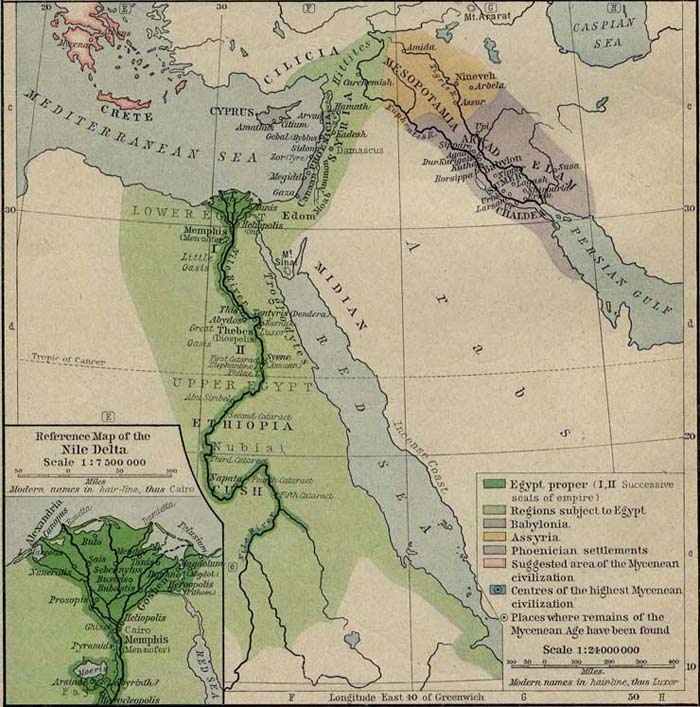
The Egyptian Empire spread from the Nile up the Eastern shore of the Meditarranean
Throughout the time of the ancient legends of Israel, the true God was Pharoah.
His laws were to be obeyed. His power permeated existence.
The Biblical legends, largely written from the security of Babylon,
camouflage this by postulating a supernatural deity, consistent with current theology.
By this time the Egyptian Empire had been largely absorbed into the Babylonian.
The politics and alliances of the nations at this time are shifting and complex,
but the Biblical picture lacks both evidence and credibility.
The anti-Egyptian bias of Babylonian politics also permeates the stories.
Three corrolaries emerge from this new vision of historical reality:
1. The Exodus story is a distortion of the facts.
The Israelites were resettled by the Egyptians into a recently conquered area,
to exploit the riches of the Jordan valley and deny it to their enemies,
as is apparent from reading Judges 6:7-9 with new eyes.
2. "The Law" could have from an Egyptian source
The Law is described as God given at a time when God was Pharoah.
Moses was probably an Egyptian appointed to oversee the tribes.
However the details of the Law may be attributable to Babyloian sources.
3. The Judges stories have little credibility.
They derive from reports of border disputes on the empire's fringes.
The story of Gideon lends itself to easy analysis,
in which the hero is an Egyptian appointee sent to sort things out,
the Angel is an Egyptian envoy and God is, of course, Pharoah.
At that time and place there was no other God!